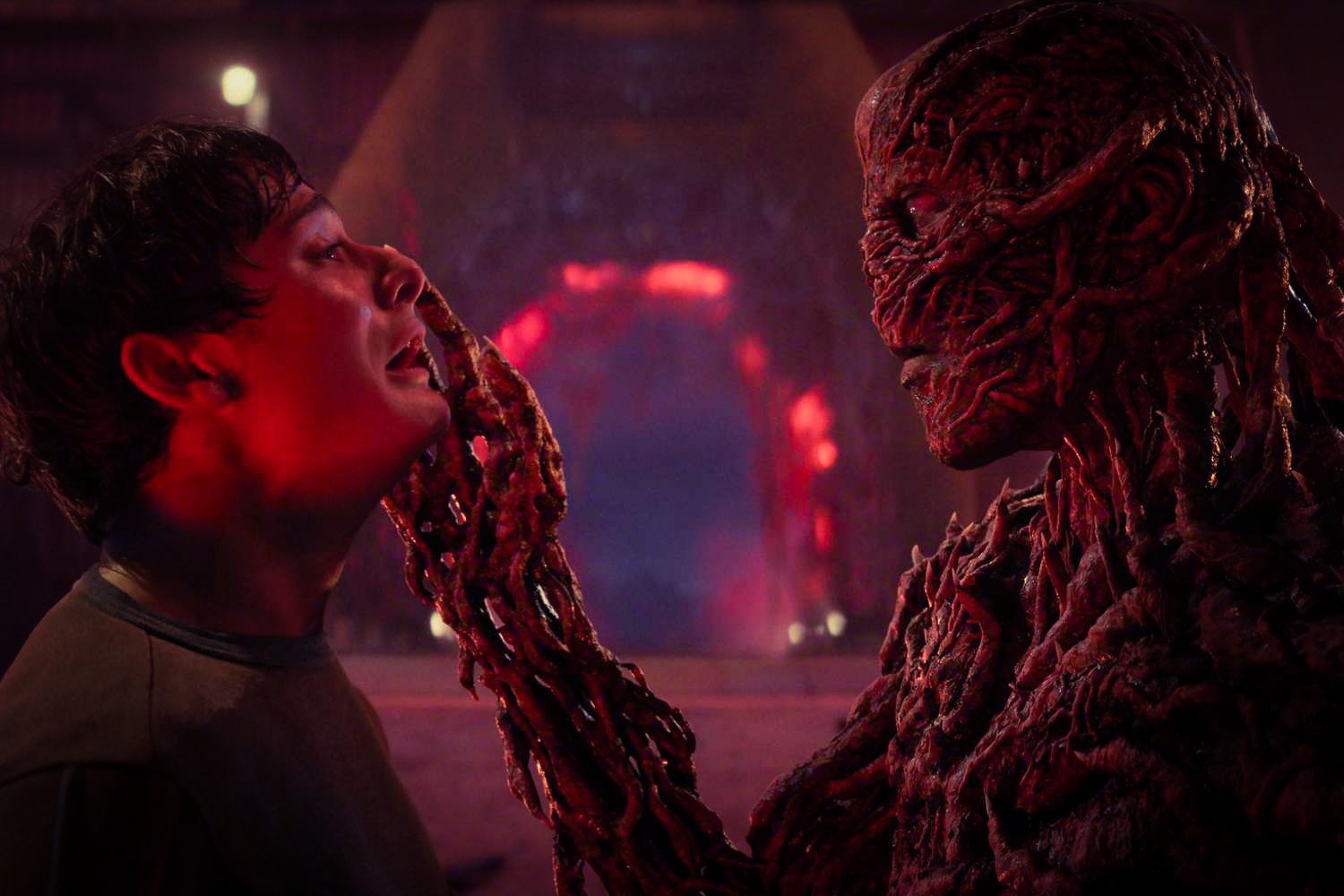
Stranger Things Season 5 is officially the final season, and Netflix has confirmed that there will be no Season 6 continuation of the original Hawkins storyline. However, the Duffer Brothers have announced that two spinoff projects—including an animated series Stranger Things: Tales from ’85 launching in 2026 and a live-action spinoff with entirely new characters and mythology—will expand the universe beyond Hawkins. While the tale of Eleven, the Upside Down, and the town of Hawkins has concluded, the creative story universe of Stranger Things is far from finished.
Introduction: Why Stranger Things Remains Netflix’s Cultural Phenomenon
Since its debut in 2016, Stranger Things has captivated global audiences, including millions of Indian viewers, by blending nostalgic 1980s Americana with supernatural horror and deeply emotional storytelling. The show’s perfect balance of sci-fi action, mystery, and coming-of-age drama transformed it into a cultural phenomenon that redefined streaming television. Netflix’s decision to release Season 5’s finale on New Year’s Eve 2025, accompanied by theatrical screenings in over 350 cinemas across North America, underscored the show’s monumental significance. Yet this momentous release marks not a new beginning, but a definitive ending to one of television’s greatest sagas.
The mystery surrounding Hawkins, Indiana—a small town haunted by an interdimensional portal and dark government secrets—has kept audiences on edge for nearly a decade. With Season 5 now concluded, fans are inevitably asking: what happens next? Does the Hawkins story truly end, or is there more mystery waiting to be uncovered? The answer requires understanding both what Season 5 delivered and why the Duffer Brothers have firmly closed the door on this particular chapter of their expanding Stranger Things universe.
Is Stranger Things Season 6 Even Possible?
The question is straightforward, but the answer deserves clarity: there will be no direct Season 6 of Stranger Things. The Duffer Brothers have been explicit and unambiguous about this in recent interviews. According to reports from Variety and Newsweek, they confirmed that Season 5 represents the definitive conclusion to the story of Eleven, Vecna, and the Upside Down as audiences have known it. This was not a decision made lightly—the creators spent years crafting the final arc to ensure that the story reached a satisfying, intentional conclusion rather than leaving loose threads for future seasons.
However, the absence of Season 6 does not signal the end of Stranger Things content. Instead, the Duffer Brothers are pivoting toward spinoffs and continuation stories set in different decades with entirely new characters and mythologies. As Matt Duffer stated in an exclusive interview, “This is the end of the story for these characters of Hawkins, for the Upside Down. It’s a different decade and different characters, but of course, still connected to the Stranger Things universe”. This distinction is crucial: the Hawkins saga has concluded, but the Stranger Things universe—the larger mythology connecting government experiments, parallel dimensions, and supernatural forces—will continue to expand through these new projects.
The State of Hawkins After the Finale: A Town Forever Changed
The Season 5 finale left Hawkins in a profoundly altered state. Throughout the series, the town endured multiple supernatural disasters—from the Demogorgon’s initial appearance in Season 1 to the catastrophic opening of multiple rifts in Season 4’s climax. By the end of Season 5, Hawkins had become a landscape permanently scarred by its encounters with the Upside Down. The visual destruction evident in the final episodes confirmed what fans had long theorized: Hawkins itself may be forever connected to the interdimensional realm, with the consequences of four seasons of supernatural chaos leaving indelible marks on the town’s infrastructure and its residents’ psyches.
The psychological impact on Hawkins’ survivors cannot be overstated. The townspeople who witnessed the events—from the initial disappearance of Will Byers in Season 1 to the catastrophic Season 4 finale—carry deep trauma. Children who should have been innocent were forced to confront monsters and government conspiracies. Max Mayfield’s recovery, which plays a central role in Season 5, symbolizes the broader question facing Hawkins: can the town truly heal, or will the scars of the Upside Down remain permanent reminders of the horrors that transpired?
The Upside Down: A Dimension’s Mysteries Finally Addressed—But Not Fully Resolved
One of Stranger Things‘ most compelling elements is the Upside Down itself—a twisted mirror dimension frozen in 1983, teeming with alien spores and supernatural creatures. Season 5 provides crucial answers about its origins. Through a series of revelations, viewers learned that the Upside Down was not inherently evil but rather became corrupted through a combination of human intervention and Henry Creel’s (Vecna’s) malevolent will.
Specifically, the Upside Down’s true origin traces back to an ancient, pre-existing alien dimension (referred to as “Dimension X” by some fans) that existed long before Hawkins did. When Eleven made psychic contact with the Demogorgon on November 6, 1983, she inadvertently created a gateway between our world and this alien realm, thus “birthing” the Upside Down as Hawkins audiences know it. Henry Creel, after being thrown into this realm by a young Eleven, bonded with the dimension’s living particle cloud and transformed it into a hive mind under his control, creating Vecna.
However, the Season 5 finale does not fully explain every mystery surrounding the dimension. The enigmatic rock found in Vecna’s briefcase—which the Duffers hinted may contain remnants of the Mind Flayer—remains cryptic. The Duffers acknowledged this ambiguity intentionally, revealing that the rock’s true significance will be explored in the upcoming live-action spinoff rather than in the main series. This narrative choice reflects the Duffers’ philosophy: Stranger Things intentionally leaves some mysteries unresolved, honoring the show’s commitment to mystique and the idea that not all questions have neat answers.
Vecna’s Defeat: The Villain’s Final Fate and What It Means for Evil in the Upside Down
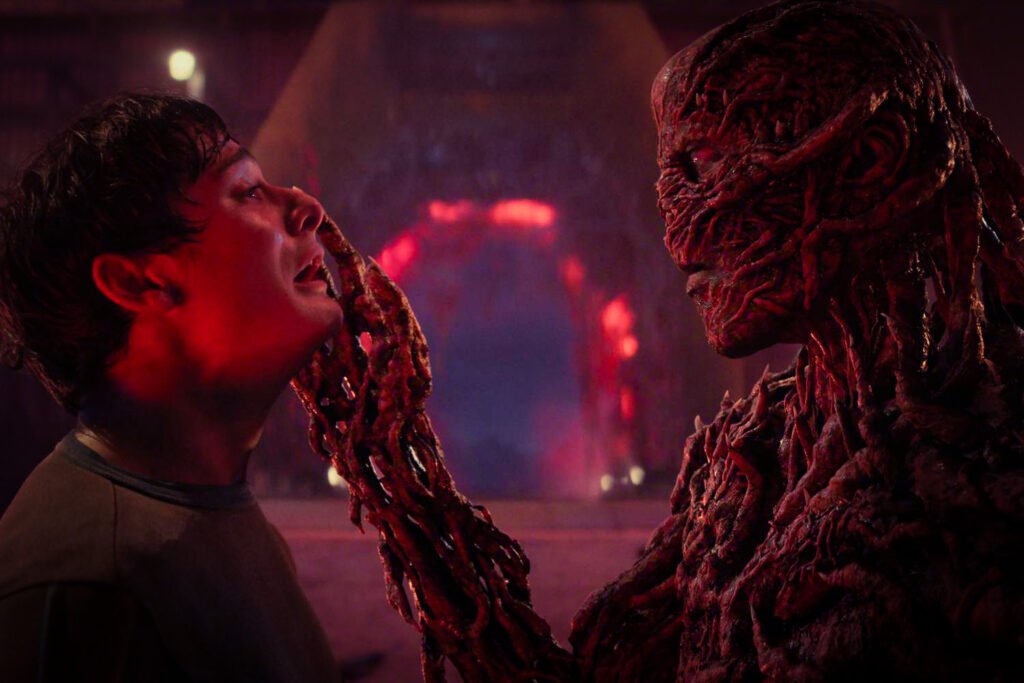
The Season 5 finale delivers a climactic confrontation with Vecna that fundamentally alters the supernatural landscape of the Stranger Things universe. After four seasons of manipulating timelines, murdering teenagers to tear open dimensional gates, and attempting to merge the two worlds, Vecna’s reign finally ends. Yet his defeat raises philosophical questions: was Vecna an inherently evil entity, or was he a tragic figure twisted by circumstance and Hawkins Lab’s experimentation?
The show’s portrayal of Vecna evolves throughout Season 5. Rather than depicting him as a one-dimensional villain bent on destruction, the narrative suggests that Henry Creel—the man beneath the monster—was a disturbed child whose psychic powers manifested in violence, only to be further corrupted when thrust into the alien dimension. His connection to Will Byers, revealed to be intentional rather than coincidental, demonstrates how Vecna viewed the Upside Down not as a tool for conquest but as an extension of his own traumatized psyche.
With Vecna defeated, the question becomes: does evil truly end, or does it simply evolve into new forms? The Upside Down, no longer under Vecna’s direct control, exists in an uncertain state. The Duffers’ decision to leave this ambiguous rather than fully resolving it suggests that darkness in the Stranger Things universe may be an ongoing threat rather than a single enemy to be defeated. This thematic approach aligns with the show’s broader philosophy that trauma, pain, and supernatural malevolence are recurring challenges rather than problems with permanent solutions.
Eleven’s Powers: The Cost of Saving the World
Throughout Stranger Things, Eleven’s psychic abilities—specifically her telekinesis and her capacity to detect and communicate with the Upside Down—have been portrayed as both her greatest strength and her deepest wound. Every use of her powers comes at a cost: nosebleeds, physical exhaustion, and psychological toll. By Season 5, Eleven’s arc reaches a critical juncture where she must decide whether to push her abilities beyond their previous limits to defeat Vecna once and for all.
The Season 5 finale shows Eleven’s powers evolving in unexpected ways. The emotional and physical cost of using her abilities against Vecna leaves her fundamentally changed. Whether her powers remain intact, diminished, or transformed entirely by the finale’s conclusion is one of the defining character moments of the season. For Indian viewers who have followed Millie Bobby Brown’s character since Season 1, Eleven’s journey represents a broader theme about sacrifice and the burden of responsibility placed on children in extraordinary circumstances.
The finale addresses a crucial narrative question: can Eleven ever have a normal life after everything she has endured? The closing moments of Season 5 suggest a path toward potential normalcy, yet the series never offers false reassurance that trauma disappears simply because the immediate threat has been eliminated. This mature, realistic approach to post-traumatic recovery resonates powerfully with audiences who understand that real healing is gradual and incomplete.
Max’s Fate and Recovery: A Journey Through Memory and Consciousness
Max Mayfield’s storyline in Season 5 emerges as one of the season’s most emotionally complex narratives. After dying at Vecna’s hands in Season 4 and being revived by Eleven, Max finds herself in a comatose state, her consciousness trapped within Vecna’s mind—specifically within the memories of Henry Creel’s traumatic childhood. This development transforms Max from a passive victim into an active participant in the final battle, even as her physical body lies motionless in a hospital bed.
Throughout Season 5, Max’s consciousness journey becomes instrumental to the group’s strategy against Vecna. Trapped in his memories, she discovers that music—specifically Kate Bush’s “Running Up That Hill”—serves as a conduit between her consciousness and the physical world. This revelation echoes the show’s consistent use of 1980s music as a supernatural tool, transforming nostalgia into a literal lifeline. As Max explores Vecna’s mental landscape, she uncovers vulnerabilities in his psychological fortress, information that proves crucial to the final confrontation.
By the season’s end, Max’s recovery becomes a central narrative thread. The Duffer Brothers confirmed that Sadie Sink’s character would have a “purpose” in Season 5 beyond mere cameo appearances. While Max may not return to full physical ability by the finale—she may remain permanently blind or face lasting physical limitations—her consciousness and her spirit remain indomitable. Her arc concludes not with miraculous healing but with hard-won resilience, reflecting the show’s commitment to portraying recovery as messy, incomplete, and deeply human.
Will the Friend Group Stay Together, or Does Growing Up Mean Growing Apart?
A fundamental tension underlying Stranger Things from its inception is the question of childhood versus adulthood. The show’s opening seasons centered on a group of young friends united by extraordinary circumstances. Yet as the characters age—moving from elementary school to high school to early adulthood—the narrative explores whether such bonds can survive the pull of maturation, distance, and diverging life paths.
Season 5 addresses this tension head-on. The finale’s iconic image—Mike closing the basement door after the group’s final Dungeons & Dragons game—symbolizes the closing of childhood itself. This moment was envisioned by the Duffers years earlier as the thematic conclusion to the entire series: not with explosions or triumphant battles, but with the quiet, bittersweet acknowledgment that the kids can no longer simply gather in a basement to play games and escape reality.
The question of whether the friend group remains connected post-Season 5 is one the show deliberately leaves partially unanswered. Real life suggests that childhood friendships often drift, reformed through nostalgia and significant life events rather than daily interaction. The show’s refusal to guarantee that Mike, Eleven, Dustin, Lucas, Max, and Will remain as tightly knit as they once were feels honest to the experience of aging out of childhood, even as it acknowledges that the bonds formed through shared trauma and love endure in different forms.
Could the Story Expand Beyond Hawkins? Government Conspiracies and the Larger Mythology
Throughout Stranger Things, the Hawkins supernatural phenomena were presented as rare, isolated incidents. Yet the show’s deeper lore reveals that the government experiments conducted at Hawkins National Laboratory were part of a broader Cold War-era conspiracy. The CIA’s Project MKUltra and the theoretical “Montauk Project” served as real-world inspirations for the show’s fictional government machinations.
This historical grounding suggests that Hawkins was not the only location where psychic powers were being developed or where interdimensional rifts might have opened. Season 5 hints at the existence of other gifted individuals beyond Eleven—children whose abilities emerged through similar programs but in different locations. The live-action spinoff announced by the Duffers is positioned to explore exactly this expanded scope: a new town, a new decade, and new mysteries connected to the broader Stranger Things mythology but distinct from Hawkins’ specific story.
This expansion reflects the show’s evolution from a localized mystery (What happened to Will Byers in Hawkins?) to a larger exploration of institutional evil, scientific hubris, and humanity’s encounter with forces beyond its comprehension. Indian audiences, many of whom follow international entertainment news closely, will recognize this pattern in successful franchises that expand their universes through spinoffs while respecting the integrity of original storylines.
Fan Theories That Captured the Imagination: Will Byers, Time Loops, and Unresolved Questions
Throughout Season 5’s broadcast, the Stranger Things fan community generated an extraordinary array of theories attempting to predict the finale’s outcome. These fan theories, while ultimately unconfirmed, illuminate the show’s thematic depth and the investment audiences have placed in its mysteries.
One prominent theory suggested that Will Byers himself might be caught in a time loop or might not be entirely “himself” due to his ongoing connection to Vecna. Evidence for this theory included an apparent anachronism in Will’s speech referencing Melvald’s, a diner that existed during Henry Creel’s youth but not during Will’s own childhood. Fans theorized that fragments of Henry’s memories might be bleeding through into Will’s consciousness, raising the unsettling possibility that Will carried subtle traces of Vecna’s influence despite never being fully possessed.
Another compelling theory posited a time travel resolution to the final conflict. Drawing on Mr. Clarke’s early-season explanation of wormholes and their theoretical capacity to create temporal distortions, fans speculated that closing the Upside Down might trigger a time jump, allowing the characters to meet under different circumstances—erasing the trauma that defined their childhood friendships while preserving the bonds themselves. While this theory was not confirmed in the finale, its persistence speaks to audiences’ desire for redemptive, transformative endings.
A third major theory centered on the Upside Down as a manifestation of trauma rather than a purely external threat. Rather than viewing the dimension as an alien realm that simply invaded Hawkins, this interpretation suggested that the Upside Down was fundamentally connected to the emotional and psychological wounds of the characters—particularly Eleven and Will—and that defeating it required internal healing as much as external combat.
Potential Themes for the Stranger Things Universe’s Future
While Season 5 concludes the Hawkins narrative, the upcoming spinoffs are positioned to explore complementary themes that extend the Stranger Things philosophy into new contexts. The Duffers have hinted that upcoming projects will focus on healing after systemic trauma, the long-term consequences of opening doors that can’t be closed, and the ways that evil can evolve and persist even after apparent victory.
The Stranger Things: Tales from ’85 animated spinoff, set between Seasons 2 and 3, will introduce young audiences to the beloved characters in a new format while exploring stories that occurred in the gaps between the live-action seasons. This project demonstrates the creators’ commitment to expanding the universe through different formats and perspectives rather than simply extending the main narrative.
The live-action spinoff, still in early development, promises to be a “clean slate”—entirely new characters in a different decade with different mythology, yet spiritually connected to the broader Stranger Things universe. The Duffers’ emphasis that they will not be day-to-day showrunners of this project signals a conscious effort to preserve the integrity of the original while allowing new creative voices to contribute to the expanding mythology.
What a Stranger Things Story Could Look Like Beyond Hawkins
While Season 6 of the original series will not happen, the architecture of the Stranger Things universe allows for countless variations on its core themes. Future projects might explore government psychic programs in different locations, parallel supernatural phenomena in other towns, or even the long-term societal consequences of the world knowing that interdimensional portals exist and can be opened.
The animated Tales from ’85 represents one model for expansion: taking familiar characters and exploring their stories in visual mediums that allow for different storytelling possibilities. The live-action spinoff represents another: introducing entirely new characters and mysteries while maintaining thematic and mythological continuity with the original series.
Indian audiences, accustomed to expansive storytelling universes across Bollywood and streaming platforms, will likely embrace this approach. The Stranger Things universe’s expansion mirrors successful franchise strategies seen in properties like the Marvel Cinematic Universe, where standalone stories exist within a larger, interconnected mythology.
Conclusion: Does the Hawkins Mystery Truly End?
The Hawkins story has ended. Season 5 delivers closure to the narrative arc that began with Will Byers’ disappearance in 1983 and culminated in the final confrontation with Vecna in 1987. The basement door closes. The kids move on. The Upside Down remains, but without the immediate threat of interdimensional invasion that defined the first five seasons.
Yet the broader question of whether the Stranger Things mystery is truly resolved depends on how one defines “resolution.” For the story of Hawkins and its inhabitants, the answer is yes—Season 5 provides a definitive, intentional conclusion. For the mythology of the Stranger Things universe—the question of where supernatural powers originate, how many other gifted individuals exist, what other government programs might be operating in secret, and whether Dimension X harbors threats beyond Vecna—the mysteries remain open, waiting to be explored through future spinoffs and projects.
In this sense, Stranger Things represents a new model of television conclusion: not a full explanation that answers every question, but a respectful ending to one chapter while acknowledging that the larger universe has infinite stories waiting to be told. The Hawkins kids’ journey has concluded, but the Stranger Things saga—the broader exploration of supernatural mysteries, government secrets, and human resilience in the face of darkness—is far from finished.
For Indian entertainment audiences who have followed this groundbreaking series for nearly a decade, Season 5’s finale offers both closure and invitation: closure for the beloved characters whose growth and trauma defined the show, and an invitation to explore what comes next in a universe that has proven endlessly generative of mystery, emotion, and wonder.

Asif Ali is an entertainment content creator and movie enthusiast at Movie Trend. I covers the latest movie news, OTT updates, and trending entertainment stories with a focus on accuracy, originality, and reader value.