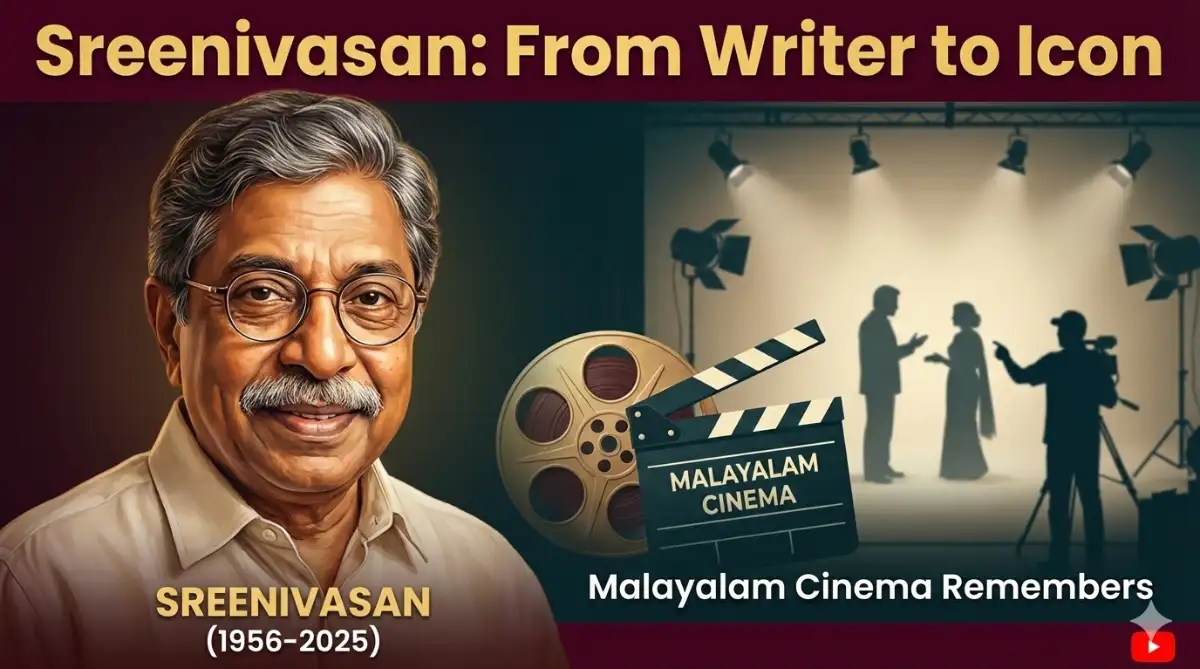
Veteran Malayalam actor, screenwriter, and filmmaker Sreenivasan passed away on 20 December 2025, at the age of 69. The legendary figure, who revolutionized Malayalam cinema through exceptional storytelling and versatile performances, died at Government Taluk Hospital in Tripunithura, Kochi. He is survived by his wife Vimala and their two sons, Vineeth Sreenivasan and Dhyan Sreenivasan, both accomplished filmmakers. Sreenivasan’s death marks the end of an extraordinary era in Malayalam cinema, leaving behind a legacy of over 225 films across five decades.
Latest Update: Sreenivasan’s Sudden Demise Shocks Film Industry
The beloved filmmaker had faced prolonged health complications in recent years. He was en route for dialysis treatment when he suddenly developed breathing difficulties and was rushed to Government Taluk Hospital in Tripunithura, where he succumbed at approximately 8:30 AM on Saturday morning. His body was kept at Ernakulam Town Hall for public homage, allowing thousands of admirers and colleagues to pay their final respects. The Kerala government announced police honours for his funeral, including a bugle salute as a tribute to his immense contribution to arts and culture. His final rites were scheduled with full state honours, reflecting the nation’s respect for his cinematic legacy.
Background: From Economics Graduate to Cinematic Legend
Sreenivasan was born on 6 April 1956 in Pattiom, a village near Thalassery in Kannur district, North Malabar region of Kerala. He came from modest beginnings—his father was a school teacher and mother a homemaker. He completed his education at Kuthuparamba Middle School and Government High School before pursuing a bachelor’s degree in economics from PRNSS College. His journey into cinema was unconventional; he initially aspired to act but eventually became recognized for his groundbreaking screenwriting work.
His career commenced in 1976 with a minor role in Manimuzhakkam. His breakthrough came in 1979 with Sanghaganam, his first lead role. However, his true calling emerged when he began writing screenplays in 1984 with director Priyadarshan’s satirical comedy Odaruthammava Aalariyam. This film immediately showcased his exceptional talent for blending humour with social commentary. The late 1980s and 1990s witnessed Sreenivasan’s golden period. His prolific collaborations with director Priyadarshan and later with director Sathyan Anthikad produced some of Malayalam cinema’s most beloved classics.
The Legacy of 225 Films and Numerous Awards
Over nearly five decades, Sreenivasan wrote screenplays for over 20 critically acclaimed films. His screenwriting credits include Odaruthammava Aalariyam (1984), Sanmanassullavarkku Samadhanam (1986), Gandhinagar 2nd Street (1986), Nadodikkattu (1987), Pattanapravesham (1988), Varavelpu (1989), Sandesam (1991), Midhunam (1993), Mazhayethum Munpe (1995), Udayananu Tharam (2005), and Njan Prakashan (2018). He won two Kerala State Film Awards for Best Screenplay. He also received a National Film Award, two Filmfare Awards South, and six Kerala State Film Awards, cementing his status as one of Malayalam cinema’s most awarded creators.
Nadodikkattu (1987), directed by Sathyan Anthikad and starring Mohanlal, remains one of his masterpieces. The film followed two unemployed men navigating the harsh economic realities of 1980s Kerala, brilliantly capturing the anxieties of jobless youth. It became a generational touchstone and was later remade in multiple Indian languages, testifying to its universal appeal and Sreenivasan’s exceptional storytelling ability.
As a director, Sreenivasan proved equally masterful. Vadakkunokkiyanthram (1989), his directorial debut starring opposite Parvathy, explored the dark comedy of marital discord and won three Kerala State Film Awards. Chinthavishtayaya Shyamala (1998) won the National Film Award for Best Film on Other Social Issues. Njan Prakashan (2018), written and produced by Sreenivasan, became one of Malayalam cinema’s highest-grossing films, earning ₹52 crore worldwide within 40 days of release.
Breaking Cinematic Conventions: Revolutionary Storytelling
Sreenivasan fundamentally altered how Malayalam cinema told stories by refusing to glorify heroism in traditional sense. The characters he created—jobless youth, middle-class men grappling with insecurity, ordinary women asserting agency—dismantled conventional notions of cinematic heroism. Instead of larger-than-life protagonists engaged in physical confrontations, his narratives focused on the internal struggles and contradictions of average Malayalis.
His work synthesized humour with social consciousness uniquely. Films like Varavelpu, Sandesam, and Midhunam employed laughter as an outer layer beneath which lay incisive portraits of social decay. This signature method—using satire as a vehicle for social awareness—addressed serious issues including unemployment, marital discord, sexual harassment, corruption, and societal hypocrisy, making audiences laugh while confronting uncomfortable truths.
Vineeth Sreenivasan: Carrying Forward the Legacy
Vineeth Sreenivasan, the eldest son, has carried forward his father’s creative legacy into contemporary Malayalam cinema. Born on 1 October 1984, Vineeth is an accomplished actor, director, producer, and screenwriter. He made his acting debut in Cycle and delivered notable performances in Traffic (2011), Om Shanti Oshana (2014), and Mukundan Unni Associates (2022).
As a director, Vineeth has established considerable talent. His directorial debut Malarvadi Arts Club (2010) was critically and commercially successful. He followed with Thattathin Marayathu (2012), Jacobinte Swargarajyam (2016), and Hridayam (2022), all receiving widespread appreciation. His younger brother Dhyan Sreenivasan is also an established actor, ensuring the family’s cinematic contributions continue for generations.
Industry Tributes: A Cinema Legend Mourned
Following Sreenivasan’s death, tributes poured in from across the film and entertainment industry. Kerala The Chief Minister said that only a handful of filmmakers have managed to portray the everyday struggles of ordinary people as effectively as he did, using humour and meaningful storytelling to make audiences reflect. He added that Sreenivasan challenged and changed many deeply rooted traditions in cinema.
Opposition Leader V D Satheesan characterized him as “an extraordinary artist who captured the lives of small people in a vast world. A multifaceted genius of Malayalam cinema, Sreenivasan turned everything he touched into gold.”
Conclusion: A Legacy That Transcends Time
Sreenivasan’s death marks the end of a distinctive era in Indian cinema. A man who rose from modest beginnings to become one of cinema’s most respected creative voices, he spent nearly five decades crafting stories reflecting the lives and struggles of ordinary Malayalis. Whether through screenwriting, performances, or direction, he consistently demonstrated an unparalleled ability to capture human complexity with humour and compassion.
His legacy extends far beyond his films. He altered how Malayalam cinema told stories, proving that entertainment and social consciousness were complementary. He demonstrated that common people’s lives deserve cinematic treatment and that laughter could effectively convey serious social messages. The entire Malayalam film industry mourns the loss of Sreenivasan, recognizing that his passing marks the end of an extraordinary era defined by artistic integrity and narrative sophistication.

Asif Ali is an entertainment content creator and movie enthusiast at Movie Trend. I covers the latest movie news, OTT updates, and trending entertainment stories with a focus on accuracy, originality, and reader value.